
The Role of AI in Predicting Match Outcomes
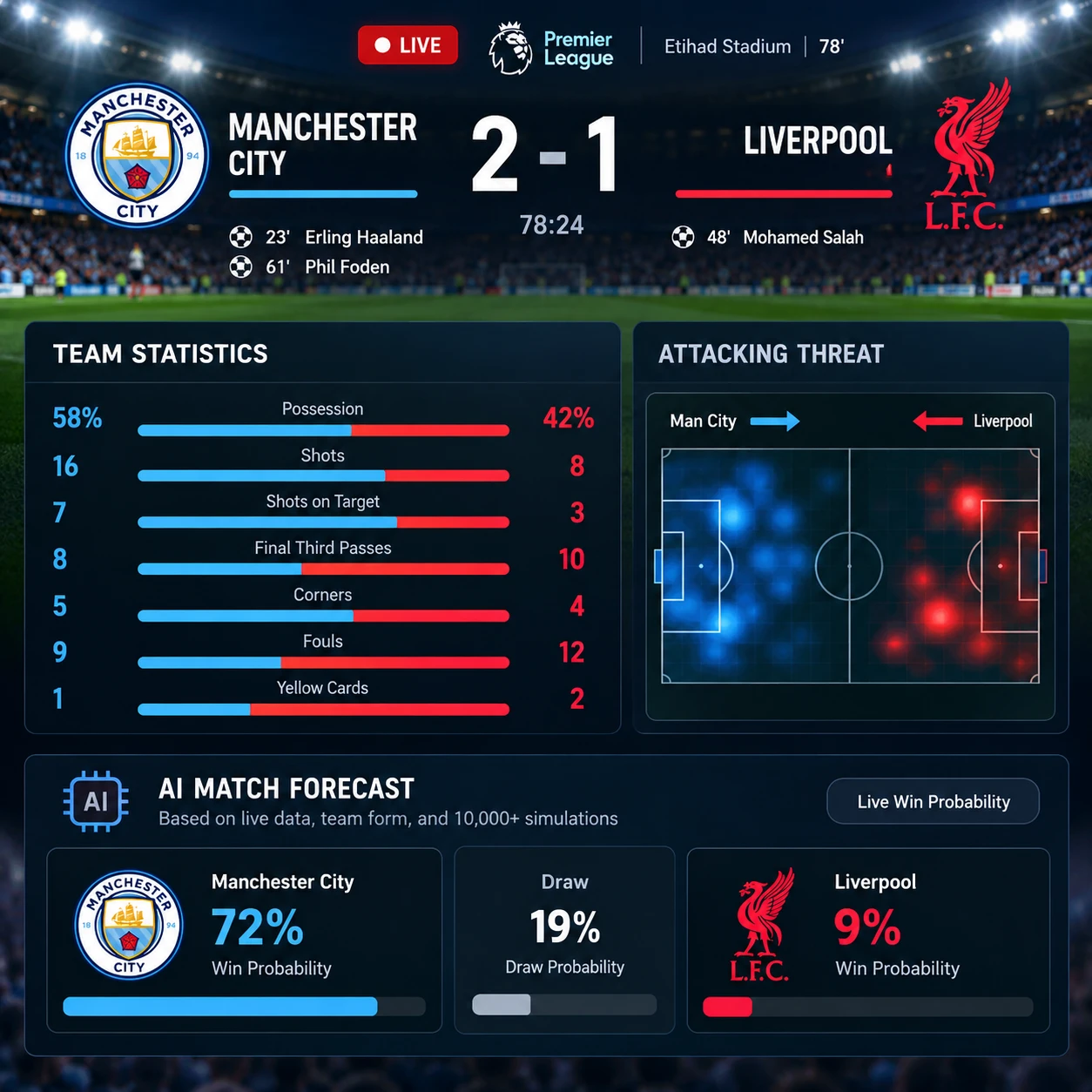
Artificial intelligence can sift through thousands of sports statistics to estimate how likely each match result may be. For fans following live sports scores, these forecasts add context to team form and match events, but they remain probability estimates—not promises of a win.
Understanding how an AI prediction is built makes it easier to read one sensibly. The key is to look at the information behind the number, notice how the forecast changes during play, and keep uncertainty in view.
How AI Models Forecast Sports Results
AI models forecast sports results by learning patterns in past and current data, then estimating how likely different match outcomes are. They turn information such as team performance and historical results into probabilities that can be updated as new data arrives.
Machine learning is one method used to build these predictive models. During training, a model examines examples of past matches alongside known outcomes. It may learn that certain combinations—such as a team’s attacking record, its opponent’s defensive record, and home advantage—tend to occur more often with particular results.
Before making a forecast, developers choose what the model should predict. That could be a win, draw, or loss; a likely score range; or the chance of a specific event. The model then weighs relevant features and produces an estimate. A separate model, or a different setup, may be needed for another league or sport.
Predictions are only as useful as the data and assumptions behind them. A model trained on older results might miss changes in a team’s style or personnel. A system focused on broad team statistics may also overlook a matchup detail that matters in one particular game. AI helps organize evidence; it does not remove the need to interpret it.
What Data Can Shape a Prediction?
AI predictions can use historical results, team and player statistics, confirmed lineups, injury information, and live match events. The mix depends on the sport, the data available, and whether the forecast is made before kickoff or during play.
Historical performance data gives a model a starting point. This can include recent results, goals or points scored and conceded, home and away records, and performance against comparable opponents. Longer-term history may help identify a team’s general level, while recent form can reflect changes in performance. Neither tells the whole story on its own.
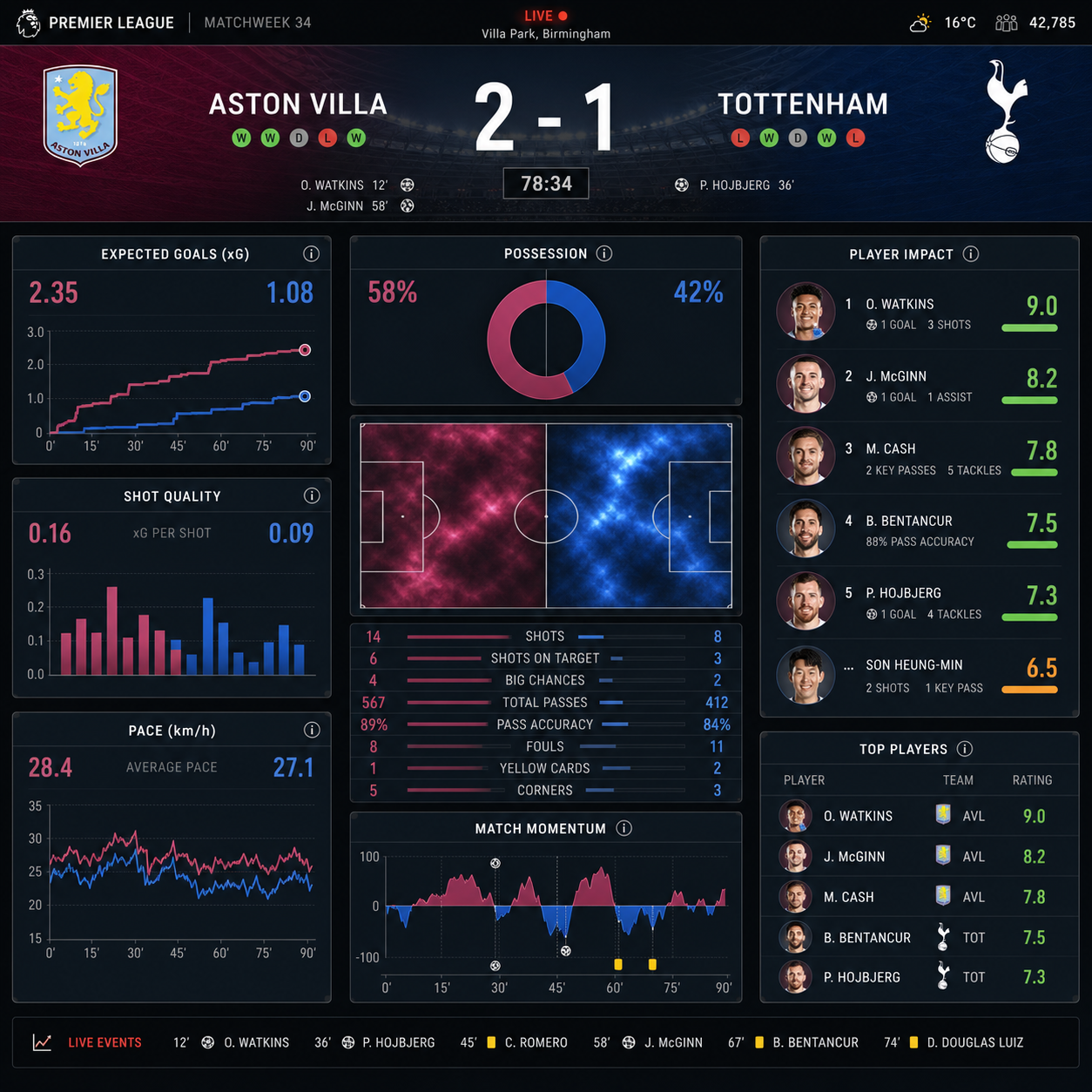
Team and player statistics add detail. A football model might consider shots, possession, expected goals, passes into dangerous areas, and defensive actions. In basketball, relevant inputs could include shooting efficiency, turnovers, rebounds, and player minutes. Stats are useful when they describe repeatable performance, but a single number can mislead without context. Possession, for example, does not necessarily mean a team created the better chances.
Injuries and lineups can shift a forecast, especially when a key player is unavailable or a team changes its usual formation. A model can only account for information it receives. If a lineup is unconfirmed or injury reports are incomplete, the prediction may reflect an assumption rather than a verified update.
Once the match begins, live match data can include the score, time remaining, substitutions, cards, shots, and other sport-specific events. Data quality matters: a delayed event feed can make a live forecast briefly out of step with what fans see on the field.
Pre-Match Forecasts vs. Live Predictions
Pre-match forecasts estimate outcomes using information available before play; live predictions update those estimates as the score and match events change. A forecast can therefore shift substantially between the opening whistle and the final result.
Before a game, a predictive model may weigh team strength, recent performance, venue, and expected lineups. That gives fans a baseline: an estimate of the likely outcome if the match unfolds within the range of situations the model has considered.
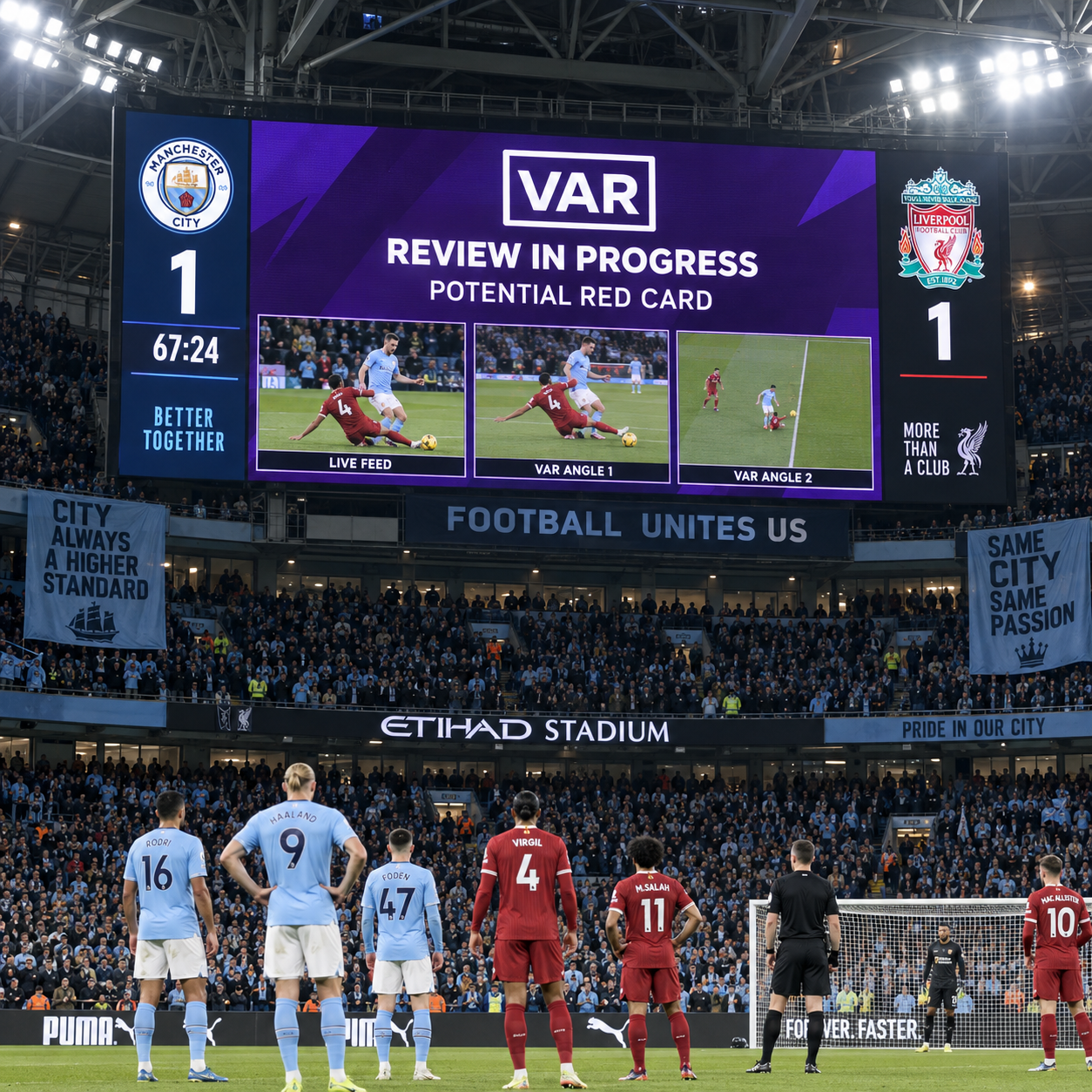
During play, live match data changes the picture. A goal can make one result more likely, while a red card, injury, or late substitution may alter the balance again. The clock matters too. A team leading by one goal with a few minutes remaining faces a different outcome landscape from a team holding the same lead early in the match.
Imagine a pre-match forecast gives the home team a 45% chance of winning. If it scores early, the live estimate may rise; if its goalkeeper is later sent off, it may fall. The exact movement depends on the model and its inputs, so there is no universal percentage change for a given event.
Live forecasts are snapshots, not settled verdicts. An update may arrive after an event, and a scoreboard or data provider can have its own delay. Compare the prediction’s timestamp with the latest score before drawing conclusions.
How to Read AI Predictions
Read an AI prediction as a probability, not a certainty: it describes how likely an outcome is according to the model and available data. A higher probability means the model favors that result, but it does not guarantee it will happen.
Suppose a match forecast assigns a team a 60% chance to win, a 25% chance to draw, and a 15% chance to lose. These figures express the model’s estimate across possible outcomes. They do not mean the team will win 60% of the match, nor that it is certain to win this particular game.
Check what the percentages refer to. Some displays show the chance of a match result; others predict a score, a goal, or another event. Also look for whether the figures add to 100% when the outcomes are mutually exclusive and cover every possibility. The provider should make clear what is being estimated.
Confidence and probability are not always the same thing. A model may strongly favor one outcome while still having limited-quality inputs, such as uncertain lineups or sparse historical data. When available, check whether a forecast includes a confidence interval, source notes, or an explanation of its factors. If it does not, treat the number as a useful summary rather than a full account of the evidence.
One practical rule: ask what changed since the last forecast. If the score, player availability, or match state changed, a new probability may be reasonable. If nothing material changed, a small fluctuation may reflect model updates or data noise rather than a meaningful shift in the game.
Limitations and Sources of Uncertainty
AI predictions can be wrong because sports outcomes depend on uncertain events, data can be incomplete, and models cannot reliably represent every factor that affects a match. Even a well-built model offers an estimate, not a complete account of what will happen.
Unexpected events can quickly change a game: a deflection, penalty, injury, officiating decision, or sudden change in weather may have a major effect. Some events are recorded only after a delay, and others are difficult to encode consistently. A model cannot respond accurately to information it has not received.
Data can also carry gaps or bias. A player may return from injury without enough recent minutes to establish current form. Statistics collected across different competitions may not be directly comparable. Historical performance can become less relevant when a coach changes tactics or a team brings in new players.
- Overtrusting a single forecast: A clear percentage can look definitive, but it represents one model’s estimate. Compare the forecast with match conditions and the data source.
- Ignoring timing: A pre-match prediction may not reflect a late lineup change. Check whether it has been updated since team news or a major live event.
- Treating a wrong result as proof that the model is useless: A 70% favorite can still lose. Review the model over many predictions, not one match.
These limitations matter most when a display gives a precise-looking number without explaining its source or update time. Precision in the presentation does not guarantee precision in the underlying estimate.
Using Predictions Alongside Live Scores
Use AI predictions alongside live scores by checking the match state, forecast timing, and key events before interpreting a probability. The score tells you what has happened; the model estimates what might happen next under its assumptions.
A simple score–state–source check can keep forecasts in perspective:
- Score: Confirm the current score and clock on a reliable live scoreboard.
- State: Check relevant events such as a sending-off, injury, substitution, or change in momentum.
- Source: See when the AI prediction was updated and what information it includes.
This approach is more useful than reacting to a percentage alone. If a live forecast changes after a goal, that is understandable. If it has not updated despite a major event, the feed may be delayed or the model may not use that event as an input.
Consider predictions as one way to understand the match, alongside live commentary, verified team news, and the sports scores themselves. Different models may disagree because they use different data, assumptions, or methods. That disagreement is a reminder that no forecast has a complete view of the future.
AI is most helpful when it makes changing match conditions easier to follow. Keep the score and game context in front of you, and treat every probability as a provisional estimate. That lets fans use predictive models for insight without confusing a forecast with a result.
Frequently Asked Questions
Can AI predict a match outcome accurately?
AI can estimate match outcomes using patterns in historical and current data, but accuracy varies by sport, competition, data quality, and model design. Even a reliable forecast can be wrong about an individual match because probabilities describe likelihoods, not guarantees.
What data does AI use to predict sports results?
Depending on the sport and model, AI may use historical results, team and player statistics, home or away performance, lineups, injuries, and live events such as goals, cards, or substitutions. Missing or delayed data can affect the forecast.
Do AI predictions change during a live match?
Yes. Live predictions can change as the score, time remaining, lineups, and match events change. The update depends on the model and the speed and completeness of its live data feed.
Why can an AI prediction be wrong?
A prediction can be wrong because of unexpected events, incomplete data, changing team conditions, or factors a model does not capture well. It can also be a reasonable probability estimate for an outcome that simply did not occur.